Commercial gutters
Professional Commercial Gutter Installation in Spartanburg, South Carolina
Commercial gutter installation in Spartanburg SC is a volume calculation before it is anything else. A warehouse roof can shed thousands of gallons during a single Upstate thunderstorm, and a residential-scale gutter will not carry it.
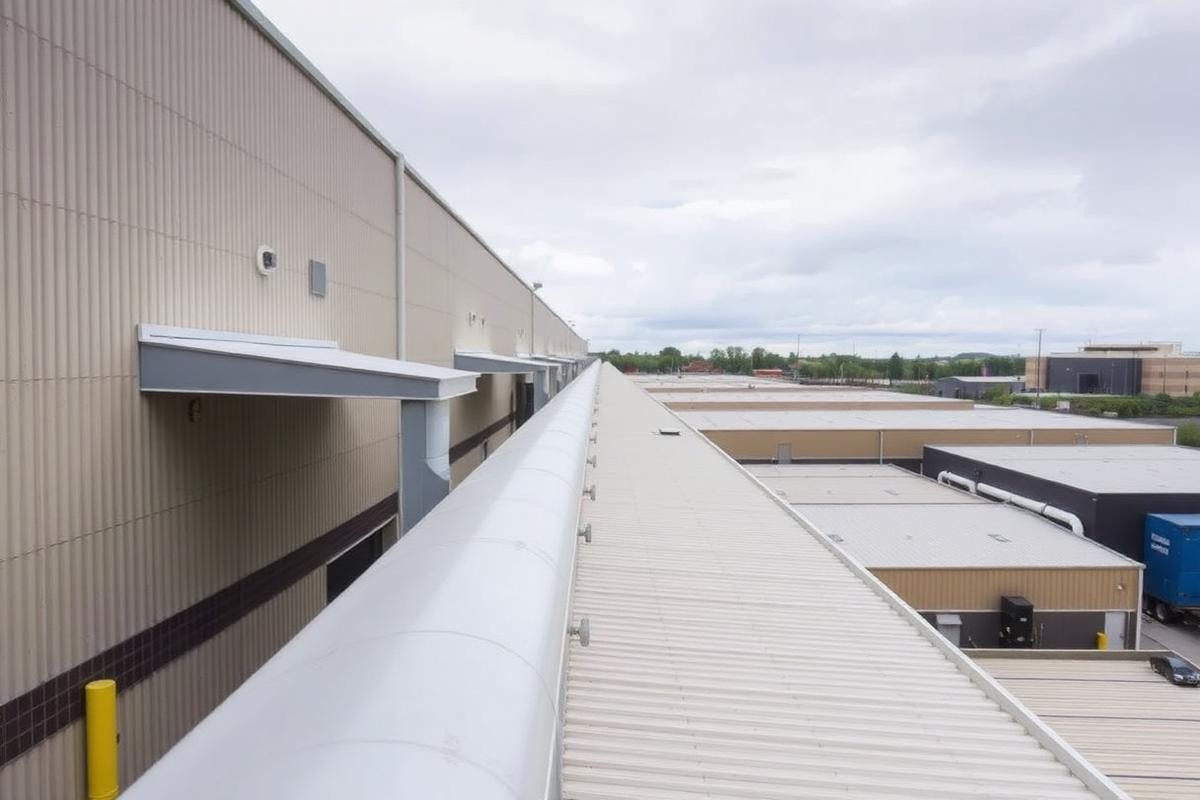
Properties we work on
Commercial gutter work covers a wide range of building types, and each brings a different drainage constraint:
- Warehouses and distribution buildings — very long roof planes with few natural discharge points, common throughout the industrial corridors around Spartanburg.
- Manufacturing and industrial facilities — metal roofing that sheds fast, plus equipment, dock aprons, and traffic areas that cannot be allowed to flood.
- Retail centers and strip developments — customer entrances and sidewalks directly beneath the roof edge, where overflow is a slip hazard and a liability issue.
- Churches — steep, complex rooflines, tall gables, and historic detailing that constrains how a gutter can be attached and where downspouts can run.
- Multifamily and apartment communities — many separate buildings, repeated details, and drainage that has to work across a whole site rather than one structure.
- Office buildings and mixed-use — appearance and finish matter alongside capacity, and downspouts must route around glazing and entries.
Sizing for large-volume water management
The calculation behind a commercial system is the roof area draining to each outlet, multiplied by a rainfall intensity figure appropriate to this region, adjusted for roof pitch. Steep metal roofs deliver water to the edge faster than a low-slope membrane, which means the gutter has to absorb a sharper peak rather than a steady flow.
Where a house is well served by a 5- or 6-inch K-style trough, a commercial roofline commonly needs a 7-inch profile or a fabricated box gutter, with downspouts and outlets scaled to match. Undersizing shows up as water sheeting over the front edge in every heavy storm — onto loading docks, walkways, parking surfaces, and building entries.
Box gutters and commercial profiles
A box gutter is a rectangular trough, typically fabricated from heavier-gauge material and sized to the building rather than pulled from a standard catalog. The rectangular section carries more water per inch of height than a K-style profile and can be built wide where the roofline allows. Box gutters are the usual answer on metal buildings, long industrial rooflines, and anywhere the calculated volume exceeds what a conventional profile can move.
Larger-profile K-style systems remain appropriate on many commercial buildings — smaller offices, churches with residential-scale eaves, and multifamily structures — particularly where appearance matters and the volume does not require a box.
Commercial downspouts and discharge
Downspouts on a commercial building are sized and spaced from the same calculation as the trough. Oversized rectangular or round downspouts move substantially more water and resist blockage from the leaves and debris that collect on a large roof.
Where the water goes afterward is a site-planning question. Discharge may need to tie into an existing storm system, route to a designated drainage area, or run underground to keep it away from traffic lanes and pedestrian surfaces. Downspouts in dock areas and drive lanes also need protection or placement that keeps them out of the path of equipment.
Growth along the I-85 and I-26 corridors
Commercial and industrial construction along the I-85 and I-26 corridors through Spartanburg County has added a great deal of large-roof square footage, and large roofs concentrate a great deal of water. Newer facilities generally arrive with engineered drainage; older buildings that have been expanded, re-roofed, or repurposed often run drainage that was sized for the original structure and never revisited. That mismatch is one of the most common causes of chronic overflow at existing commercial properties.
Replacement, new installation, and maintenance
On existing buildings we assess what is currently installed, identify where the capacity or the pitch falls short, and quote either targeted correction or full replacement. On new construction we work from the roof plan and coordinate with the schedule so gutters are installed on completed edge detail.
Ongoing repair and maintenance covers separated seams, failed hangers on long runs, damaged downspouts, and clearing of outlets. Property managers responsible for multiple buildings often prefer to have all of it assessed at once. Related work is covered under gutter and fascia repair, and debris management options are on the gutter guards page.
Smaller commercial buildings sometimes use the same approach as residential work — see seamless gutter installation for how those systems are formed and hung.
Getting a commercial estimate
For commercial work we need roof dimensions or a roof plan, the existing gutter and downspout configuration, known problem areas, discharge constraints on the site, and any access limitations such as operating hours or dock traffic. Send us the property details or call to arrange a walk-through.
Related services
Other gutter work we handle
Coverage
Commercial coverage across Spartanburg County
29316
Boiling Springs
Newer subdivisions, large rooflines and fast residential growth north of the city.
29369 / 29334
Moore & Duncan
Highway 290 and I-85 corridor homes with steep, complex roof designs.
29302
Eastside Spartanburg & Converse Heights
Established neighborhoods under a mature hardwood canopy.
29349
Inman & Campobello
Northern Spartanburg County properties with heavy tree cover and open runoff.
Large roof, large volume, correct system
Send the roof details and we will size the trough, the outlets, and the downspouts to what the building actually sheds.