Repair services
Professional Gutter, Soffit & Fascia Repair in Spartanburg, South Carolina
Gutter repair in Spartanburg SC is often the right answer. Plenty of systems that look like they need replacing are actually a pitch correction, a handful of hangers, a resealed miter, or one section of fascia board away from working properly again.
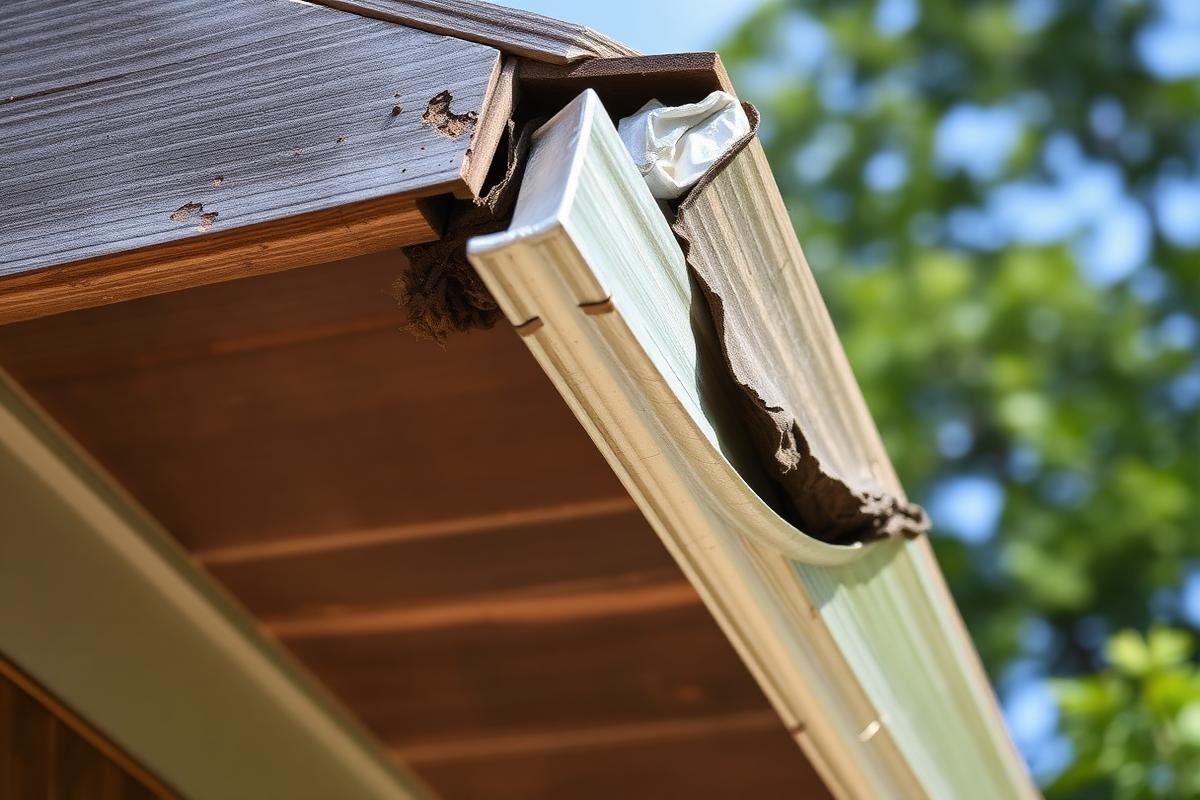
Gutter problems we repair
Sagging and loose gutters
A run that dips in the middle is holding water where it should be moving it. The cause is usually hangers that have loosened, hangers spaced too far apart for the span, or fascia that has softened so the fasteners no longer have solid wood to grip. Re-hanging with correct spacing fixes the first two; the third requires dealing with the board behind the gutter first.
Leaking joints and miters
Corners and end caps are sealed connections, and sealant has a service life. On sectional gutters, every connector along the run is another candidate. A leaking miter that drips onto a porch column or a walkway is usually a straightforward reseal or a re-fabricated corner.
Improper slope
Gutters need a consistent fall toward the outlet. When pitch is wrong or has shifted, water pools at the low point, sediment settles there, and the added weight makes the sag worse over time. Standing water in the trough after a rain has stopped is the tell.
Overflow
Overflow has several distinct causes: blockage in the trough, a blocked downspout outlet, an undersized gutter for the roof feeding it, or water overshooting from a steep roof or valley. We diagnose which one you have, because clearing debris out of a gutter that is simply too small will not stop it happening again. If sizing is the issue, the fix is a properly sized seamless system.
Damaged hangers and fasteners
Old spike-and-ferrule installations back out over time as the wood expands and contracts. Hidden hangers screwed into sound fascia hold considerably better, and switching over is a common part of a repair.
Broken or inadequate downspouts
Downspouts get knocked loose, crushed at the elbow, or disconnected at the outlet. Some were never adequate to begin with — too few for the roof area or too narrow, which makes them clog readily. Adding an outlet or upsizing from 2x3 to 3x4 frequently resolves a chronic overflow at one corner of a house.
Storm damage
Wind, falling limbs, and hail affect gutters directly. A limb strike can dent a run, tear it loose from the fascia, or crush a downspout. We assess what can be repaired and what genuinely needs replacing.
How gutter problems reach the fascia and soffit
The fascia is the board running along the roof edge that the gutter hangs on. The soffit is the panel enclosing the underside of the eave. Both are protected from weather as long as water is captured by the gutter and carried away.
When a gutter holds standing water, overflows repeatedly, or leaks at the back edge, that moisture can reach the fascia. Wood that stays damp for extended periods is vulnerable to decay, and painted surfaces can begin to fail from behind. Because the deterioration happens behind the gutter, it is commonly unnoticed until the gutter starts pulling away or a soffit panel discolors and sags. Other factors contribute too — roof edge detailing, drip edge, ventilation, paint condition, and the age of the material all play a part — so we assess what is actually happening rather than assume the gutter caused everything.
Fascia board replacement
When a section of fascia has gone soft, replacement is the practical fix. Compromised board is removed, the underlying rafter tails and roof edge are checked, and new material is installed and finished. This is best done with the gutters off, which is why fascia work is often bundled into a gutter replacement. Hanging new gutters on deteriorated fascia is the fastest route back to a sagging system.
Soffit repair
Damaged soffit shows up as stained, sagging, or separating panels under the eave, and sometimes as pest entry where a gap has opened. Repair involves removing affected sections, checking the framing above, and reinstalling with attention to the ventilation the attic depends on — sealing a soffit up solid is its own problem.
Repair or replace: how we decide
Repair generally makes sense when the issues are localized and the gutters are correctly sized, structurally sound, and not corroded — a few hangers, one corner, a pitch correction, a downspout addition. Replacement becomes the better value when problems repeat across multiple runs, when a sectional system is failing at joint after joint, when the material is pitted or corroded, or when the gutter is simply too small for the roof. In that last case no amount of repair changes the outcome.
If you are already replacing, it is a good moment to consider leaf protection, since guards integrate best when installed with a new system. Larger buildings are covered under commercial gutters.
Schedule an inspection
We look at the full perimeter, not just the spot that is dripping — hanger condition, pitch, seams, outlet sizing, fascia and soffit condition, and where each downspout discharges. You get a clear description of what is wrong and what it takes to fix it. Request an estimate or call to set up a look.
Related services
Other work we handle
Service areas
Gutter repair across Spartanburg County
29316
Boiling Springs
Newer subdivisions, large rooflines and fast residential growth north of the city.
29369 / 29334
Moore & Duncan
Highway 290 and I-85 corridor homes with steep, complex roof designs.
29302
Eastside Spartanburg & Converse Heights
Established neighborhoods under a mature hardwood canopy.
29349
Inman & Campobello
Northern Spartanburg County properties with heavy tree cover and open runoff.
Find out whether it's a repair or a replacement
We will tell you plainly which one your gutters need — and why.