Seamless gutter installation
Professional Seamless Gutter Installation in Spartanburg, South Carolina
Seamless gutter installation in Spartanburg starts with a coil of aluminum and a roll former parked at your curb. Each run is fabricated to the exact length of your roofline, so the only joints in the entire system are at the corners and the downspout outlets.
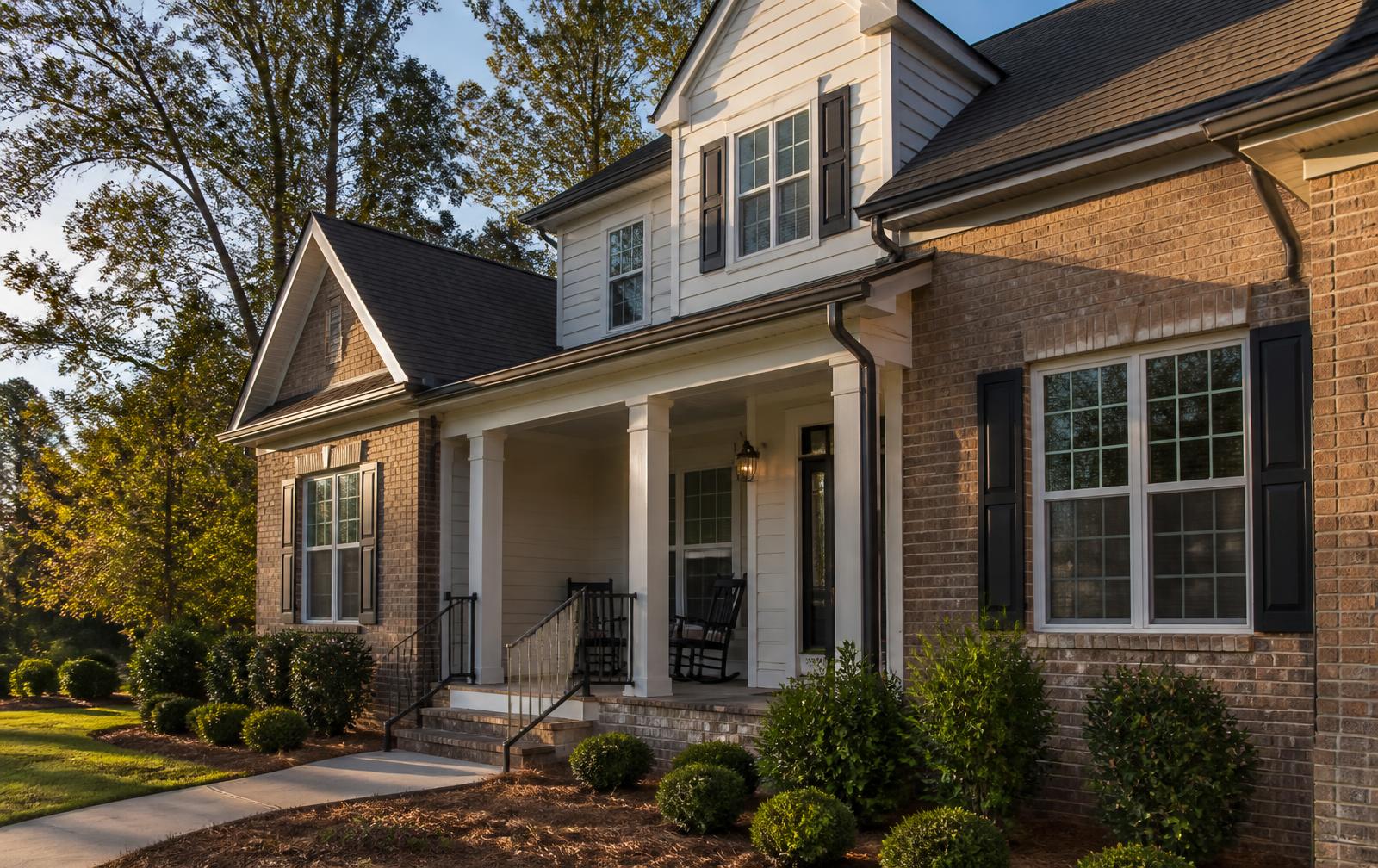
Seamless versus sectional gutters
Sectional gutters come in pre-cut lengths, usually ten feet, and are joined together on the ground with connectors and sealant. Every one of those joints is a future leak. Sealant is flexible when new, but it hardens, the aluminum expands and contracts through Carolina summers and winters, and eventually the joint weeps. Debris also catches on the internal lip of each connector, which is why sectional systems clog at predictable intervals along the run.
A seamless gutter is formed continuously from a single coil, so a forty-foot side of a house becomes one forty-foot gutter. There is no mid-run joint to fail and no internal ridge for leaves to hang on. The visible line along the fascia is also cleaner, which matters more than people expect on a front elevation.
6-inch K-style seamless gutters
K-style is the profile most Spartanburg homes use — the flat back, ogee front face that reads like crown molding from the ground. The question is not the profile but the size. A 6-inch K-style trough carries substantially more water than the 5-inch standard and pairs with 3x4 downspouts instead of 2x3.
We recommend 6-inch when the roof justifies it: large square footage, steep pitch that accelerates runoff, long valleys that dump a wide catchment into one short gutter section, or metal roofing that sheds water fast. Many newer homes in Boiling Springs and Moore and Duncan fall into that category and were originally built with gutters a size too small for their own rooflines.
Aluminum, gauge, and finish
Most residential seamless gutter in this market is aluminum, and gauge matters. Heavier 0.032-inch aluminum resists denting from ladders and limbs and holds its shape better across long spans than the thinner stock commonly used on builder-grade installations. Aluminum will not rust, takes a baked finish well, and is light enough that hangers are not fighting the weight of the gutter itself.
Color is chosen to match either the trim or the roof. Dark bronze, black, and deep charcoal finishes have become popular on newer construction; classic whites and almonds still read correctly on traditional brick homes. Copper and half-round profiles are specialty options that some homeowners in Converse Heights ask about for architectural reasons — ask us about availability for your project.
Miters, hangers, and the details that decide longevity
Corners are where a gutter system is made or broken. A properly fabricated miter is cut and sealed to shed water into the run rather than out the joint. Hangers should be spaced to support the loaded weight of the gutter — water is heavy, and a run that looks fine dry can bow under a hard rain if hangers are too far apart or anchored into soft fascia.
Pitch is equally unglamorous and equally important. A gutter needs a slight, consistent fall toward each outlet. Too little and water stands in the trough, breeding mosquitoes and accelerating corrosion at the low spot; too much and the gutter visibly tilts against the roofline.
Downspout sizing and placement
The trough collects; the downspouts do the actual work of removal. Placement is planned around where the roof concentrates water, where the ground can accept discharge, and where a downspout will not run across a walkway or a door. We also look at the count: adding one more outlet is frequently a cheaper and more effective fix than upsizing the entire gutter.
Discharge matters too. A downspout that empties eighteen inches from a brick foundation is feeding water back toward the crawlspace. Extensions, splash blocks, or underground drainage carry it out to a point where the grade takes it away.
New construction and existing-home replacement
On new construction we coordinate around the roofing and trim schedule so gutters go up on finished, painted fascia. On replacement work the old system comes down first, which is also the moment the fascia gets inspected. If there is rot behind the old gutter, it gets addressed as part of the job — see soffit, fascia and gutter repair for what that involves.
If tree cover is heavy at the property, it is worth deciding on gutter guards during the installation rather than after. Guards installed at the same time as new seamless gutters integrate cleanly with the hanger layout and roof edge.
Larger buildings follow a different specification path entirely — see commercial gutter installation.
What happens when you request an estimate
We look at the roof, measure each run, count the corners and outlets, check the condition of the fascia, and note the tree situation. From there you get a written estimate that specifies gutter size, gauge, color, downspout size and count, and any fascia work required. Nothing about pricing is guessed at from the curb. Request a gutter estimate or call to get on the schedule.
Related services
Often handled at the same time
Where we install
Seamless gutter installation across the county
29316
Boiling Springs
Newer subdivisions, large rooflines and fast residential growth north of the city.
29369 / 29334
Moore & Duncan
Highway 290 and I-85 corridor homes with steep, complex roof designs.
29302
Eastside Spartanburg & Converse Heights
Established neighborhoods under a mature hardwood canopy.
29349
Inman & Campobello
Northern Spartanburg County properties with heavy tree cover and open runoff.
Also serving Spartanburg proper — see all gutter services.
Ready for gutters that fit your roof?
We measure the runs, size the system to the roof area, and put it in writing before any work begins.